

Ari Margiono (The Jakarta Post) Jakarta Sat, April 30, 2022
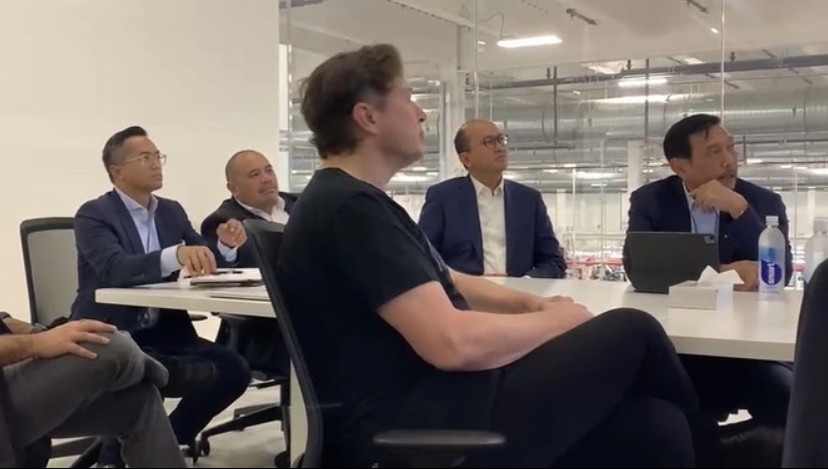 Deep in concentration, (left to right) Anindya Bakrie, Pandu Sjahrir, Elon Musk, Rosan Roeslani and Luhut Pandjaitan meet to discuss investment in Indonesia, in Texas, the United States, on April 27, 2022. (Instagram of Anindya Bakrie)
Indonesian Coordinating Maritime and Investment Minister Luhut Binsar Pandjaitan recently met with United States entrepreneur Elon Musk at Tesla headquarters in Austin, Texas to discuss the company’s potential investment in Indonesia.
Social media was flooded with pictures of the minister and his entourage shaking hands with Musk who wore a black T-shirt. The Jakarta Post (April 27, 2022) reported that the visit aimed at exploring Tesla’s partnership in the electric vehicle (EV) battery value chain in Indonesia.
In the last few years, Indonesia has been approaching several major global technology players to jumpstart the digital transformation in Indonesia. A few technology companies have started to take part in these initiatives.
In fact, several initiatives by the government and industry to establish industrial clusters is beginning to kick off the development of a technology-based economy in Indonesia.
While this is good progress toward the digitalization of Indonesia, inviting them to invest and come to Indonesia is not sufficient. There is a lot of homework that Indonesia needs to do.
One important issue is related to how are we going to geographically design our technology clusters so that they grow organically and sustainably? Are the government and the industry the only drivers for the technologization of Indonesia?
To appropriately design sustainable technology and entrepreneurial clusters, we need to learn from the US and other countries in developing these city clusters, more popularly known as a “technopolis” (Smilor et al., 1989).