


Passing the Innovation Baton: How Design Thinking Drives the Global Relay
Passing the Innovation Baton: How Design Thinking Drives the Global Relay
By Raissa Listy Almanda
Entrepreneurship & Incubation Section Head,
Center for Innovation, Design, and Entrepreneurship Research (CIDER)
BINUS University International
Estimated reading time: 3–5 minutes
At BINUS University International, international experience and critical thinking are fundamental components of the student learning journey. To cultivate these essential skills in a truly borderless environment, the university proudly takes part in the Working Around the World (WAW) program.
WAW is a collaborative global initiative that leverages international time zones to create a continuous, 24-hour design sprint. Instead of operating as a traditional hackathon where separate teams compete against one another, WAW connects universities across the globe to collaborate on a single, evolving project. As the Earth rotates, students pass their work from east to west—inheriting, improving, and transferring the solution to the next country in line.
On September 29, 2026, the latest installment of this global relay took international collaboration to new heights with a timely new theme: “AI for Humanity”.
When solving complex global challenges, where do you begin? For the Center for Innovation, Design, and Entrepreneurship Research (CIDER) at BINUS University International, the answer is always the same: you begin with humanity.
In the 2026 WAW challenge, students from multiple universities across three countries proved that human-centered innovations know no time zones. While typical hackathons task separate teams with competing for individual solutions, WAW operates as a true global relay. International universities share ownership of a single project, passing the design baton across time zones as a solution evolves from Version 1 to Version 4.
At the heart of this continuous process is Design Thinking—a structured, human-centric framework that ensures every line of code, interface design, and gamified feature remains anchored in real human needs.
The 4-Stage Global Design Thinking Relay
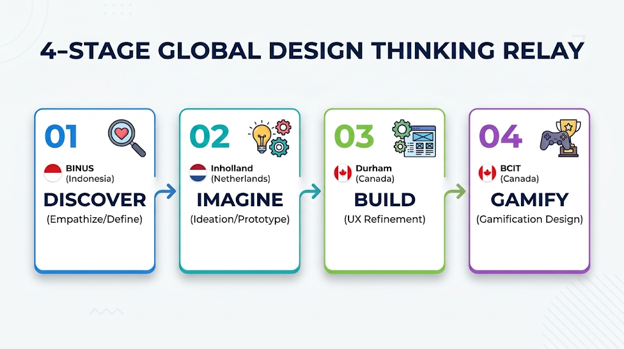
Stage 1: DISCOVER — Grounding AI in Human Empathy
Lead University: BINUS University International (Indonesia)
Design Thinking Focus: Empathize & Define
Before touching technology, students must understand the human experience. Led by CIDER’s core design philosophy—“Do not begin with AI. Begin with humanity”—BINUS students initiated the 2026 relay by diving deep into human contexts.
Through evidence collection, user interviews, and emotional mapping, the teams identified user pain points to build comprehensive Empathy Maps (capturing what users Say, Think, Do, and Feel). Rather than starting with pre-assigned AI topics, the students discovered genuine human struggles and framed actionable How Might We (HMW) problem statements.
The Output (V1): A validated human problem statement and empathy map passed east-to-west to Europe.
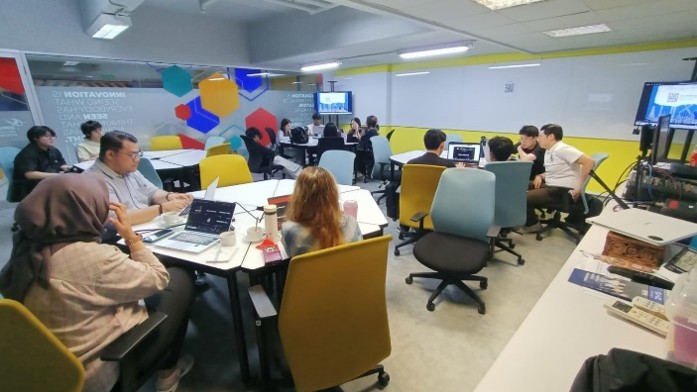
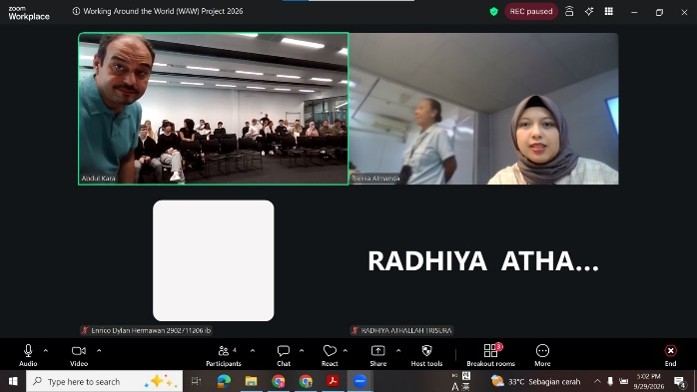
Stage 2: IMAGINE — Cross-Cultural Brainstorming & AI Value
Lead University: Inholland University (The Netherlands)
Design Thinking Focus: Ideation & Early Prototyping
Inheriting the V1 insights, the students at Inholland underwent a phase—reframing and absorbing the user context developed in Indonesia without restarting the project.
Using structured ideation methodologies, the teams generated potential ideas per group before putting them through an AI Opportunity Lab. Here, the students asked critical design questions: Does AI create meaningful value here that other technologies cannot? Is it responsible?
The Output (V2): A concrete solution concept, initial user journeys, and low-fidelity interface wireframes transferred across the Atlantic Ocean.
Stage 3: BUILD — Rapid Iteration & UX Polish
Lead University: Durham College (Canada)
Design Thinking Focus: Prototype Refinement & Usability
Receiving the V2 concept, the Canadian teams focused on functional architecture and user experience. The Durham students assumed specialized roles—Prototype Builders, Experience Testers, and Technical Support—to decode the inherited concept and asked: “How can we make this solution work better?”
Through rapid user testing, the students pinpointed interface friction, streamlined AI-driven interactions, and improved functional clarity.
The Output (V3): An interactive, refined digital prototype ready for engagement design.
Stage 4: GAMIFY — Gamification Driven by Empathy
Lead University: St. Lawrence College / BCIT (Canada)
Design Thinking Focus: Experience Design & Engagement
A unique principle of the 2026 WAW program is for gamification to emerge from empathy. Rather than layering on superficial points, badges, or leaderboards, the students engineered game mechanics that directly addressed the emotional barriers uncovered back in Stage 1. The teams turned abstract AI interfaces into engaging, meaningful human experiences.
The Final Output (V4): A gamified, interactive prototype was designed to motivate positive behavior change, serving as the capstone of the 2026 global relay.
Why Design Thinking Matters in Global Collaboration
The Working Around the World challenge proves year after year that Design Thinking is more than just a problem-solving toolkit—it is a universal language. By decentralizing the design sprint across international institutions, students learn to put aside individual pride of authorship to build upon the collective intelligence of a global team. The students ensured that every global team down the relay line remained focused on what matters most: creating technology that serves humanity.