



Exploring the Global Landscape of Venture Capital: Insights from Professor David M. Waguespack
Exploring the Global Landscape of Venture Capital:
Insights from Professor David M. Waguespack
Seminar Title : Global Venture Capital
Date : April 10, 2025
Speaker : David M. Waguespack, Associate Professor of Strategy & Entrepreneurship
Affiliation : Robert H. Smith School of Business, University of Maryland
Organized by : The Center for Innovation, Design, Entrepreneurship, and Research (CIDER), in collaboration with the International Business Program – BINUS Business School
Participants : BINUS lecturers, both onsite and online
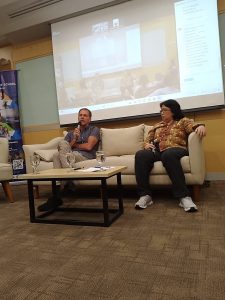
Professor David M. Waguespack sharing insights on venture capital at BINUS Business School (April 10, 2025)
Introduction
The rapidly evolving global startup ecosystem has turned venture capital (VC) into one of the most influential forces shaping entrepreneurship today. On April 10, 2025, BINUS Business School hosted an eye-opening seminar titled Global Venture Capital, featuring Associate Professor David M. Waguespack from the University of Maryland. The session was organized by the Center for Innovation, Design, Entrepreneurship, and Research (CIDER) in collaboration with the International Business Program at BINUS Business School. The seminar attracted BINUS lecturers from various disciplines, joining both in person and virtually, eager to gain deeper insights into venture capital and its impact on innovation and business growth.
With years of academic and practical experience, Professor Waguespack brought a global lens to the discussion, exploring not only the historical and structural foundations of venture capital but also the regional nuances, particularly within the Southeast Asian context.
Varieties of Entrepreneurship
The session began with Professor Waguespack laying the foundation for understanding the entrepreneurial ecosystem by identifying three core types of entrepreneurship:
- Need-based Entrepreneurship
Often informal and driven by necessity, this type of entrepreneurship emerges when individuals have limited alternatives for generating income. It is most common in developing economies and is typically resource-constrained. - Preference-based Entrepreneurship
Characterized by lifestyle choices, this form is usually run by single proprietors who aim to maintain a comfortable work-life balance. These businesses are typically small-scale, with limited aspirations for growth. - Growth-oriented Entrepreneurship
The main focus of venture capital, this type involves startups that aim to scale rapidly, often aspiring to become public companies. These ventures require significant access to capital, skilled labor, and market networks.
This typology sets the stage for a more in-depth exploration of how venture capital aligns with and supports growth-oriented entrepreneurship.
What is Venture Capital?
Professor Waguespack provided a comprehensive overview of venture capital as a subset of private equity, emphasizing its historical roots in the post-World War II United States and its explosive development in Silicon Valley during the 1960s. The VC model is based on high-risk, high-reward investing:
- Venture capitalists (VCs) raise funds from investors and invest in startups in exchange for equity stakes.
- They typically use exit strategies for their investments through initial public offerings (IPOs) or acquisitions.
- While many VC-funded startups do not succeed, those that do often yield extraordinary returns and disrupt entire industries.
Some of the world’s most successful companies—Google, Facebook, and Apple—all began with venture capital. As highlighted by Professor Waguespack, approximately 50% of public companies in the US today have received VC funding, underscoring its role in driving innovation and economic development.
Comparative Insights from Global Data
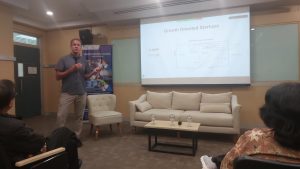
Professor Waguespack presenting visual insights from the VentureXpert dataset during the seminar.
Drawing from a massive dataset compiled from VentureXpert, a commercial database owned by Thomson Economics, Professor Waguespack shared striking comparative insights into global VC activities. The data covered:
- 813,000 investment events from 2001 to 2023
- 34,638 investor firms
- 222,917 startup companies
- 250,000 geo-coded addresses, offering granular, street-level location data
These figures were not only impressive in scale but also served as a launchpad for identifying trends in startup funding structures, syndicate behavior, investment stages, and more. The seminar participants were particularly intrigued by how this data could be used to map innovation ecosystems and understand regional investment patterns across continents.
Spotlight on Southeast Asia
One of the most anticipated segments of the seminar was Professor Waguespack’s analysis of venture capital activity in Southeast Asia. With economies like Indonesia, Vietnam, Singapore, and Malaysia emerging as vibrant startup hubs, this region offers a fascinating contrast to the more studied ecosystems of the USA, Europe, and China.
Key highlights from his Southeast Asia analysis included:
- Urban Tech Hubs: Venture capital in the region is heavily concentrated in major urban areas such as Jakarta, Singapore, and Ho Chi Minh City, where startups, investors, and talent clusters form vibrant innovation communities.
- Agglomeration and Co-location: Data showed strong patterns of co-location, where startups tend to cluster around major research universities, technology parks, or even specific streets within a city—creating localized ecosystems of innovation.
- Syndicate Behavior and Investment Trajectories: Professor Waguespack noted that the structure of investment syndicates, the size of investment rounds, and the maturity levels of startups in Southeast Asia differ significantly from their counterparts in the West. This suggests that local context matters, especially when analyzing funding dynamics and policy implications.
The participants found this regional focus especially relevant as Southeast Asia continues to rise as a strategic investment destination for global venture capitalists.
Research Gaps and Opportunities
In the final portion of the seminar, Professor Waguespack shifted gears to outline key research gaps and collaborative opportunities that could further enrich the global understanding of venture capital:
- Comparative Structures
More comparative studies are needed to explore how VC operates differently across countries and regions, especially in terms of syndicate formation, investment size, and founder-institution relationships. - Stage Diversity in Investments
The dataset reveals varying behaviors in early-stage versus late-stage investments, pointing to a need for stage-specific research that considers risk appetite, evaluation metrics, and startup development cycles. - Role of Institutions and Regulations
The speaker emphasized the importance of local institutions, such as legal systems, intellectual property protection, and tax policies, in shaping VC ecosystems. Understanding these differences can aid in the design of more supportive environments for entrepreneurship. - Micro-Geography of Innovation
With high-resolution geocoded data, there are growing potentials to explore neighborhood-level dynamics, such as how proximity to universities, coworking spaces, or transportation infrastructure influences startup success.
Final Thoughts
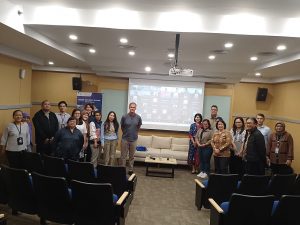
The Global Venture Capital seminar offered a rare and valuable opportunity for BINUS faculty members to engage with cutting-edge global research. Professor Waguespack’s ability to bridge academic rigor with real-world relevance, paired with his extensive dataset and comparative perspective, sparked thoughtful discussions and new research ideas among the participants.
By situating Southeast Asia within the broader venture capital landscape and highlighting the importance of data-driven, context-sensitive research, the seminar not only enriched the participants’ understanding but also positioned BINUS Business School as an active player in the global conversation on entrepreneurship and innovation. As the VC ecosystem continues to evolve, events like this serve as crucial platforms for knowledge exchange, collaboration, and capacity-building in higher education institutions.