


Facilitator Training for 100 Million Learners Bootcamp on Global Entrepreneurship and Innovation by Simon Turner from Thunderbird School of Global Management
Facilitator Training for 100 Million Learners Bootcamp on Global Entrepreneurship and Innovation by Simon Turner from Thunderbird School of Global Management
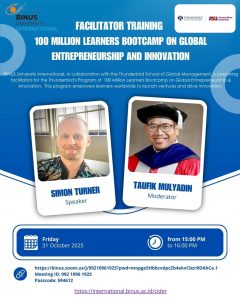
Facilitator Training for 100 Million Learners Bootcamp on Global Entrepreneurship and Innovation (October 31, 2025)
In this era of globalization and digital transformation, higher education institutions are increasingly required to equip students not only with disciplinary knowledge but also with entrepreneurial competencies that enable them to thrive in complex and competitive environments. Entrepreneurship education is no longer limited to business schools; rather, it has become an interdisciplinary priority to cultivate creativity, resilience, problem-solving, and innovation across diverse academic fields.
To strengthen this mission, BINUS University International has established a meaningful academic collaboration with the Thunderbird School of Global Management of Arizona State University (ASU). This partnership supports Thunderbird’s global initiative—the 100 Million Learners Bootcamp on Global Entrepreneurship and Innovation—which aims to make world-class entrepreneurial education accessible to learners around the globe.
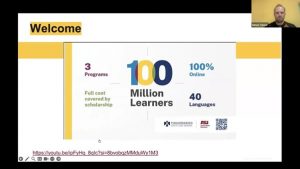
Presentation by Mr. Simon Turner from the Thunderbird School of Global Management (October 31, 2025)
As part of this collaboration, BINUS University held facilitator training for the 100 Million Learners Bootcamp on Global Entrepreneurship and Innovation on Friday, 31 October 2025. The event featured Simon Turner, from the Thunderbird School of Global Management, as the speaker, and Taufik Mulyadin, a faculty member of BINUS University International, as the moderator. The training session was conducted online and brought together facilitators and lecturers who will play a key role in guiding students through the upcoming bootcamp sessions.
The facilitator training program introduced the participants to the pedagogical framework and digital learning tools used in Thunderbird’s Entrepreneurship and Innovation Program. It emphasized experiential learning, problem-based approaches, and the integration of global case studies to help students develop entrepreneurial mindsets and practical skills. The program also aims to empower facilitators to become effective mentors who can inspire students to transform ideas into viable ventures that address real-world challenges.
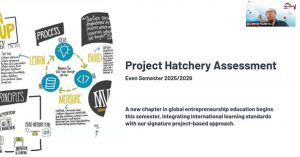
Presentation by Mr. Taufik Mulyadin from BINUS University International (October 31, 2025)
This initiative aligns with BINUS University’s vision to nurture and empower the society in building and serving the nation through world-class education and innovations. By adopting the 100 Million Learners curriculum, BINUS reinforces its commitment to providing inclusive, future-ready education that transcends traditional academic boundaries. The online format ensures that students and educators can access quality entrepreneurial learning resources anytime and anywhere, in fostering global connectivity and collaboration.
Through this partnership, BINUS University students, particularly those enrolled in the Project Hatchery program, will have the opportunity to participate in a free 18-session Online Entrepreneurship Course developed by Thunderbird. The course is designed to expose learners to fundamental entrepreneurial concepts, real-world business cases, and hands-on digital experiences that encourage critical thinking and innovation.

All Participants (October 31, 2025)
By engaging in this program, BINUS students will not only enhance their entrepreneurial knowledge but also strengthen their soft skills—such as communication, teamwork, adaptability, and leadership—which are essential for success in the rapidly evolving global economy.
Ultimately, this collaboration between BINUS University and the Thunderbird School of Global Management represents a forward-looking approach to education—one that bridges academia and industries, local and global contexts, and theory and practice. It reflects both institutions’ shared vision to empower the next generation of innovators and changemakers who will shape the future of global entrepreneurship.