


Article Paper – CLIL in an EMI Setting: a supportive scaffold in language-content collaboration
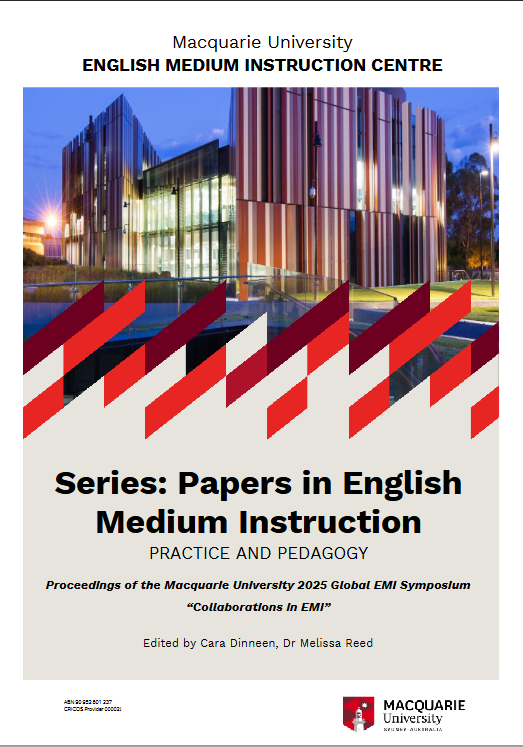
On October 23, 2025, Michael Setiawan from Binus University, Indonesia, joined an international lineup of experts and practitioners at Macquarie University’s Global Symposium – Collaborations in EMI. This event enriched the existing literature related to collaborations in EMI. Following up on the symposium, each speaker contributed an article on their respective topics. Early in 2026, Macquarie University, the event organizer, published the online proceedings. Michael’s article titled “CLIL in an EMI Setting: a supportive scaffold in language–content collaboration” brought a new concept of integrating CLIL components serving as a scaffold in an EMI setting.
The editors, Cara Dinneen and Melissa Reed from Macquarie University, commented on Michael’s article:
From Indonesia, Setiawan describes a collaboration between an English and an accounting class to support students with low English proficiency to succeed in an EMI context. Through collaborative planning, the lecturers aligned the syllabi so that the language class would function as a precursor to the accounting class each week. Essential vocabulary, discourse structures, translanguaging, and reading text analysis from the accounting module were all a part of the preparatory English class. Students reported heightened comprehension and confidence as a result of the collaboration, leading the university to shift away from English only policies and reframe what was once considered a language problem as a learning opportunity.
Here is his abstract:
Our university applies English as Medium of Instruction (EMI) for all courses. While EMI promotes internationalization, it creates burdens for students with lower language proficiency levels. They struggle to comprehend both the language and the content. To support struggling students, we implemented the Content Language Integrated Learning (CLIL) approach in selected classes with difficult content. Through collaboration and translanguaging, the language class focused on vocabulary and reading comprehension which would be discussed in the content class. The language lecturer explained the vocabulary and the definitions within the specific context discussed in the content class. Additionally, they discussed the reading materials and helped students comprehend the texts before they were further discussed in the content courses. The aim of this collaboration was that students did not have trouble understanding the content by introducing necessary language knowledge beforehand. This is evidenced by our interview with a group of low-proficiency students and the content lecturers. They confirmed that CLIL benefited both students and lecturers. It was affirmed that the language class provided students with the necessary support to follow their content class. Moreover, the content lecturer felt that her work was now much easier because most students could follow the lessons more effectively. They also noted that low-proficiency students were now more confident participating in discussions and group work because they understood the material and its specific terms. These findings suggested that integrating CLIL into an EMI setting could be transformative for students in general, and specifically for those with lower language proficiency who might have been left behind due to language barriers.
The full paper can be read on Proceedings of the Macquarie University 2025 Global EMI Symposium – Collaborations in EMI.pdf