
Exploring Culture and Communication: Paul’s Guest Lecture at BINUS @Kemanggisan
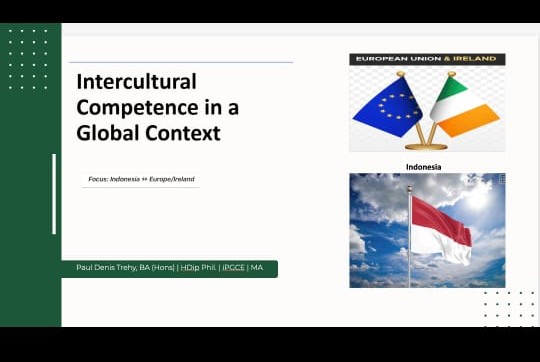
On December 1, 2025, Paul went to the Creative Digital English program at BINUS @Kemanggisan for a guest lecture on Intercultural Competence in a Global Context. The session invited students to reflect on how culture shapes communication and interaction across borders, offering both theoretical grounding and practical insights.
Paul began by unpacking the concept of culture, tracing its roots from the Latin colere—meaning to cultivate—to its modern 18th–19th century understanding as the shared beliefs and practices within a group. He then introduced two influential scholars in the field: Geert Hofstede, known for his value-based cultural dimensions, and Edward T. Hall, who examined how cultures communicate implicitly or explicitly. These frameworks provided students with tools to analyze cultural differences and similarities in everyday life.
The class engaged in a comparative discussion between Indonesia’s collectivist culture and Ireland’s more individualistic orientation, exploring how these cultural tendencies manifest in family dynamics, university life, and professional etiquette. Real-world examples helped students see how cultural norms influence behavior and expectations in both personal and professional settings.
The lecture concluded with practical tips on building intercultural competence globally, encouraging students to cultivate openness, empathy, and adaptability when interacting across cultures. By connecting theory with lived experience, Paul’s session highlighted the importance of intercultural competence as a skill that extends beyond the classroom into the realities of global citizenship.