

How Cryptocurrencies Work: A Simple Explanation
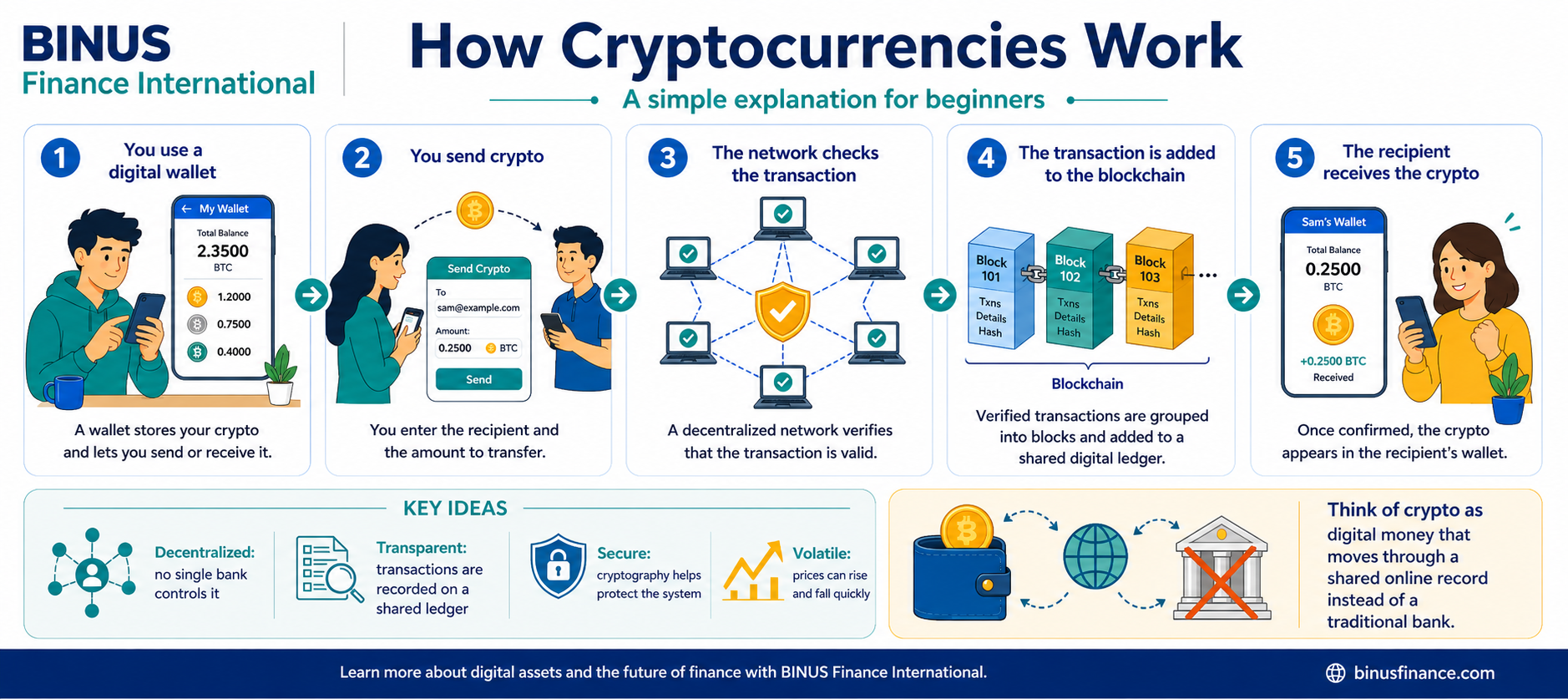
Cryptocurrency is a form of digital money. Unlike cash, it does not exist as physical notes or coins. Instead, it exists online and can be sent from one person to another through a computer network.
To use cryptocurrency, a person usually needs a digital wallet. A digital wallet is an app or software that allows users to store, send, and receive crypto. It does not “hold” coins in the same way a physical wallet holds cash. Instead, it stores the information needed to access and control your crypto.
Two important terms in crypto are public key and private key. A public key is like an account number or an email address. You can share it with others so they can send crypto to you. A private key is like a secret password or PIN. It proves that you are the owner and gives you control over your crypto. This key must be kept safe, because if someone gets it, they can access your funds.
When someone sends crypto, the transaction is checked by a network of computers. This is where the term blockchain comes in. A blockchain is a shared digital record, sometimes called a ledger, that keeps track of transactions. Instead of one bank keeping the record, many computers in the network keep copies of it. That is why crypto is often called decentralized — it is not controlled by just one institution.
Transactions are grouped into blocks, and each new block is linked to earlier ones, forming a chain — hence the name blockchain. Once a transaction is confirmed and added to the blockchain, it becomes very difficult to change.
Another common term is cryptography. This refers to the security methods and complex codes used to protect transactions and ownership. It helps ensure that crypto transfers are secure and hard to fake.
Crypto can be useful for fast digital transfers, but it also comes with risks. One key term here is volatility, which means prices can rise or fall very quickly. That is why crypto can be both exciting and risky.
In simple terms, cryptocurrency is digital money that moves through a secure shared online record, rather than through a traditional bank.