
How US–Iran Tension and a Strait of Hormuz Blockade Could Hit Indonesia
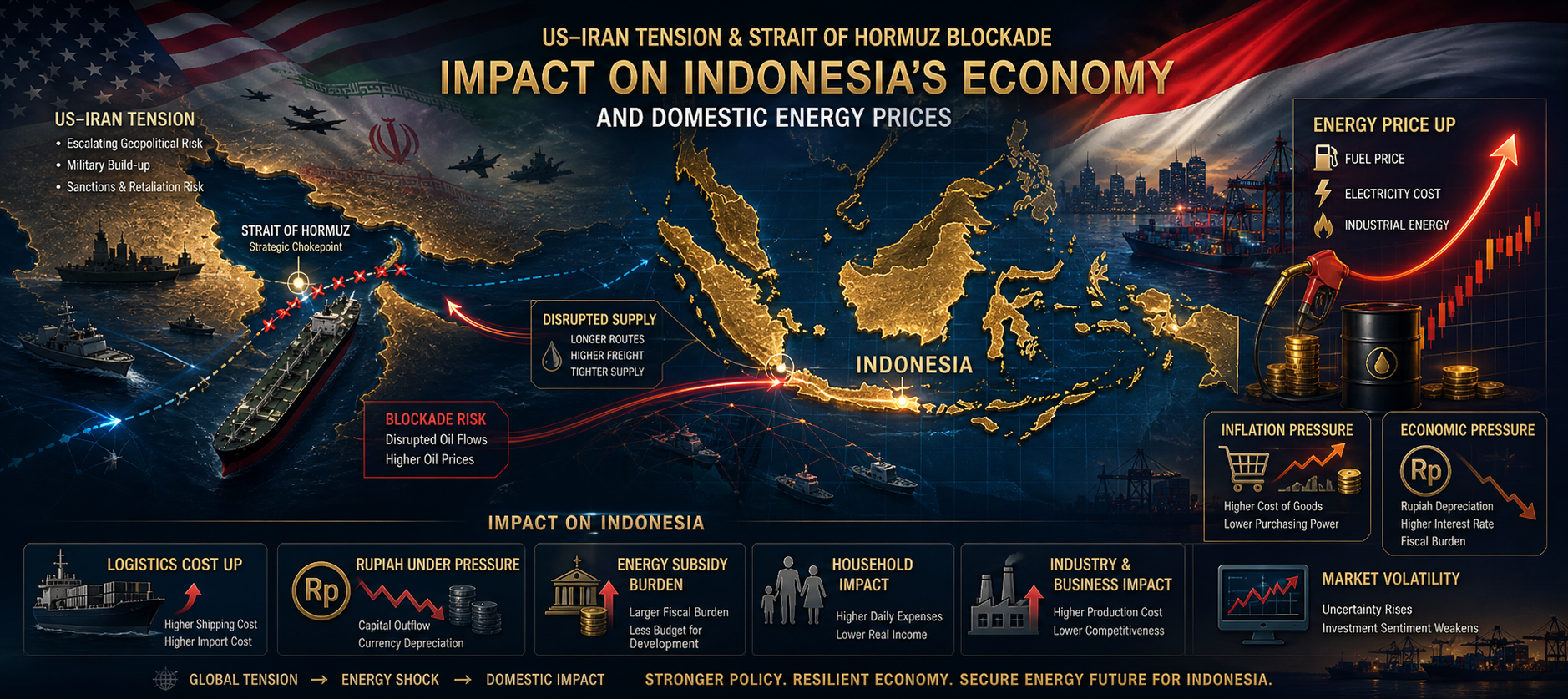
Tension between the United States and Iran is not just a regional security issue. It is also a serious economic risk for countries far beyond the Middle East, including Indonesia. One of the main reasons is the Strait of Hormuz, a narrow but highly strategic shipping route through which a significant portion of the world’s oil and gas supply passes every day.
If conflict escalates and the Strait of Hormuz is disrupted or blocked, the first impact would likely be on global energy prices. Oil markets react quickly to supply risk. Even before an actual shortage occurs, fear of delayed shipments, tighter supply, and rising transportation costs can push crude oil prices upward. That increase would then flow into domestic fuel prices, electricity costs, and industrial energy expenses.
For Indonesia, the consequences could be broad. Although Indonesia has domestic energy resources, it is still exposed to global oil price movements. Higher oil prices would increase import and logistics costs, put pressure on transportation and manufacturing sectors, and raise the cost of goods and services across the economy. This creates inflationary pressure, which directly affects household purchasing power.
There could also be fiscal implications. When global energy prices rise sharply, governments often face pressure to increase subsidies or provide relief measures to protect consumers. For Indonesia, this could mean a heavier burden on the state budget, reducing fiscal space for infrastructure, education, health, or other development priorities.
The rupiah could also come under pressure. In times of global uncertainty, investors tend to move toward safer assets, which can trigger capital outflows from emerging markets. A weaker rupiah would make imports more expensive and could further intensify inflation. At the same time, businesses would face greater uncertainty, especially those dependent on imported fuel, raw materials, and global supply chains.
The broader lesson is clear: geopolitical shocks can quickly become economic shocks. A conflict centered on the Strait of Hormuz would not remain a distant foreign policy issue. It could directly affect Indonesia’s inflation, business costs, fiscal policy, exchange rate stability, and overall economic confidence.
For students of finance and economics, this is an important reminder that markets are shaped not only by interest rates and company performance, but also by geopolitics, trade routes, and global energy security. In today’s interconnected world, a crisis in one strategic chokepoint can ripple across the entire global economy — and Indonesia is no exception.